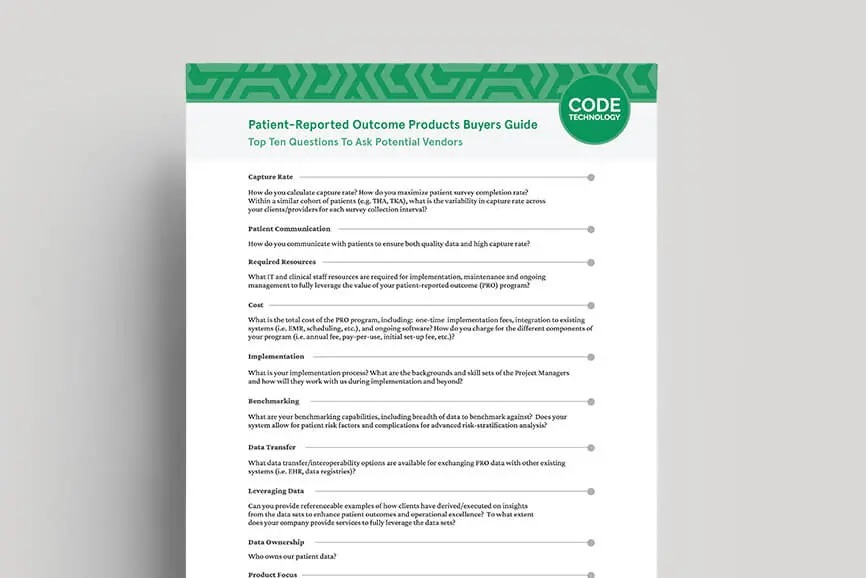

Four questions that reveal what you’re getting in an outcomes partnership.
Picture the meeting.
Your orthopedic group is choosing a patient-reported outcomes partner. On the screen, a dashboard fills with charts. A patient receives a survey. Results appear in a report. The platform looks intuitive, the presentation is polished and the price fits the budget.
Someone asks about implementation. Someone else asks about EHR integration.
Then the meeting ends.
No one has asked whether the vendor can commercialize the data. Or what happens when collection falls behind. Or whether the support everyone liked is included in the proposal.
Those questions can feel like details to work through later. But their answers shape the cost, workload and value of the program you’re choosing.
Before the next meeting ends, ask:
1. Who benefits from your outcomes data?
Your patients take time to describe their pain, function and recovery. Your organization invests in collecting those responses. That information should help you understand outcomes, support reporting, evaluate performance and improve care.
It can also contribute to research and meaningful benchmarks.
Ask a prospective partner to explain how the data may be used beyond your organization’s program.
The distinction matters. Contributing de-identified information to a registry for research is different from selling a dataset commercially. Both deserve an explanation of the purpose and permissions involved.
At CODE, we don’t sell your data. We put it to work for your organization. We welcome questions about how data supports your program, reporting, registry analysis and research.
2. Will your patients receive product offers along the way?
Ask whether patients could encounter product recommendations, promotions, or purchase opportunities through the platform or its partners.
If a patient saw a product offer through a platform they associate with your practice, would they know who was behind the offer? Could they mistake it for something their physician recommended?
If the vendor says patients may see offers, ask where they appear, whether the vendor or its partners earn revenue from them, and whether your practice can review or opt out of them.
3. Whose priorities guide your outcome partner’s decisions and future direction?
Understanding the makeup of the organization’s leadership team and board makes a bigger difference than you may think. The PROs vendor proposal describes the program as it exists today. Your organization also needs a partner that can respond when circumstances change.
Suppose your group acquires another practice. The new location has a different workflow, and collection begins to slip. Does the vendor adjust its support? Does your team take on the additional work? Is a new service agreement required?
Or a reporting requirement changes. Who evaluates the impact, communicates the next steps and helps put them into practice?
These situations reveal how a company makes decisions about staffing, investment and client service.
Ask who has an ownership stake in the company and who has authority to respond to client needs. Then ask for examples: a workflow that was adapted, a collection problem that received additional attention or a reporting change that required coordinated support.
Why does ownership matter? When an outcomes vendor is backed by private equity, its investors typically expect a return within a few years. That timeline can influence pricing, support levels, new revenue streams such as data licensing or patient marketing, and an eventual sale of the company.
CODE is independently owned. We welcome questions about how that ownership shapes our decisions and the commitments we make to clients, our roadmap and our mission to move healthcare forward.
Ownership belongs in the evaluation. So does evidence of how those priorities show up in practice.
4. When capture rates fall short, who is accountable for getting your outcome program back on track?
Many outcome vendors offer implementation assistance, patient engagement tools and professional services. The important question is how those services work for your organization.
Consider a patient who hasn’t completed an assessment. Automated reminders have gone unanswered, and the collection window is closing.
What happens next?
Ask the vendor to walk through the process. Who notices the gap? Who investigates it? What additional outreach is available? When does your team become involved?
Then examine the scope. Is that intervention included in the ongoing service, available for an additional fee or assigned to your staff?
Apply the same questions to incomplete records, changing patient information, new locations and reporting preparation. Understand who monitors progress and who takes action.
At CODE, our approach combines technology with a dedicated operations team. A useful conversation with us should make the division of work clear: what CODE manages, what your organization retains and how we coordinate when a problem needs attention.
That detail helps you compare the full service and the internal effort each option requires.
Before the meeting ends
Return to that PROs vendor presentation. The dashboard looks good. The price appears reasonable. Your team is interested.
Now ask about the relationship behind it.
Who benefits from the data? Can you explain its permitted uses? How are priorities set? What happens when the program needs more attention?
The answers belong alongside the features and price in your decision.
Your outcomes. Your data. A partner accountable to you.
Evaluating an outcome partner? Talk with CODE about how we use data, manage the work and support your organization’s goals.
#WeLoveOutcomes