
Overview of PROM Use in Robotic Inguinal Hernia Repair
A key challenge identified across multiple systematic reviews is the significant heterogeneity in how PROMs are used in inguinal hernia studies. A quantitative systematic review covering 929 studies found 81 different patient-reported outcome measures being used, with no single dominant disease-specific tool. PubMed Despite this variability, several instruments consistently emerge as frontrunners and are most frequently used in robotic inguinal hernia repair (IHR) literature.
Most Commonly Used Disease-Specific PROMs
1. Carolinas Comfort Scale (CCS)
The Carolinas Comfort Scale (CCS) is a widely used hernia-specific PROM that mostly focuses on mesh-related symptoms. It has been thoroughly investigated but unfortunately lacks evidence on content and structural validity. PubMed Central
The CCS contains 23 items measuring the severity of pain, mesh sensation and mobility impairment caused by the mesh for eight different movements: lying down, bending over, sitting up, activities of daily living, coughing or taking a deep breath, walking, walking the stairs, and exercise. The answers are recorded on a 6-point Likert scale, with 0 being an absence of symptoms to 5 being experiencing disabling symptoms. PubMed Central
In the robotic inguinal hernia repair literature specifically, the CCS has been employed in several key comparative studies. Zayan et al. used the CCS to measure patient-reported outcomes in a direct comparison of 53 robotic (37 inguinal) and 101 laparoscopic hernia repairs, finding no difference in 1-year CCS scores between robotic and laparoscopic inguinal hernia repairs. PubMed Patient-reported outcomes assessed through the CCS showed no significant differences between laparoscopic and robotic inguinal hernia repairs at various postoperative time points. MDPI
In a systematic review of inguinal hernia PROM trends, the Carolinas Comfort Scale was the most commonly used hernia-specific instrument at 5% of studies, with its use increasing from 0% in 2000–2004 to 18% in 2015–2019. PubMed
2. EuraHS-QoL (European Registry for Abdominal Wall Hernia Quality of Life) — Used in several robotic eTEP/TAPP studies
The European Registry for Abdominal Wall Hernia Quality of Life score, a 90-point scale, was utilized to quantify patient-reported outcomes in a study of robotic TAPP repair for scrotal inguinal hernias, with a mean score of 3.7 (range 0–10). PubMed
Notably, in the robotic eTEP inguinal hernia literature specifically, a prospective study of robotic e-TEP inguinal hernia repair collected EURA QS quality of life scores as their primary PROM instrument in 36 patients from August 2023 to August 2024. Springer
3. Activities Assessment Scale (AAS)
The Activities Assessment Scale (AAS) is another widely used PROM which mainly concentrates on physical limitations and ability to maintain daily living. Like the CCS, its content and structural validity have not been established yet. PubMed Central It is used less commonly than the CCS in robotic IHR studies specifically, but appears in broader inguinal hernia research.
4. COMI-Hernia (Core Outcome Measures Index for Hernia)
The Core Outcome Measures Index for Hernia (COMI-Hernia) is a hernia-specific PROM adapted from a questionnaire originally focusing on back pain. It is not as thoroughly investigated as the CCS and not as frequently used as the CCS and AAS, and also requires further structural and content validation. PubMed Central Its use in robotic IHR studies is infrequent.
5. HerQLes (Hernia-Related Quality of Life Survey)
Hernia-specific tools used in abdominal wall reconstruction studies include the Carolinas Comfort Scale (CCS), the Hernia-Related Quality-of-Life Survey (HerQLes), the European Hernia Society Quality of Life Tool (EuraHS-QoL), the Ventral Hernia Pain Questionnaire (VHPQ), Abdominal Hernia-Q (AHQ), and Hernia Recurrence Inventory (HRI). ScienceDirect HerQLes is used primarily in ventral/incisional hernia robotic repair studies rather than inguinal specifically.
PROM Trends in Robotic Inguinal Hernia Surgery
PROM use in robotic inguinal hernia repair remains sparse and heterogeneous. Most studies involving da Vinci approaches, including TAPP, TEP, and eTEP, continue to prioritize operative metrics such as operative time, recurrence, and complication rates over validated patient-reported outcomes.
When PROMs are included:
- CCS is the most frequently used disease-specific PROM in robotic IHR studies
- EuraHS-QoL is emerging in robotic eTEP studies
- VAS for pain is commonly used as a domain-specific adjunct
There are currently no evidence-based recommendations for PROM selection in inguinal hernia patients. The most practical approach remains combining a generic quality-of-life instrument with a disease-specific PROM to provide a more comprehensive assessment (PubMed Central). PubMed Central
Comparison of Disease-Specific PROMs for Robotic Inguinal Hernia Surgery
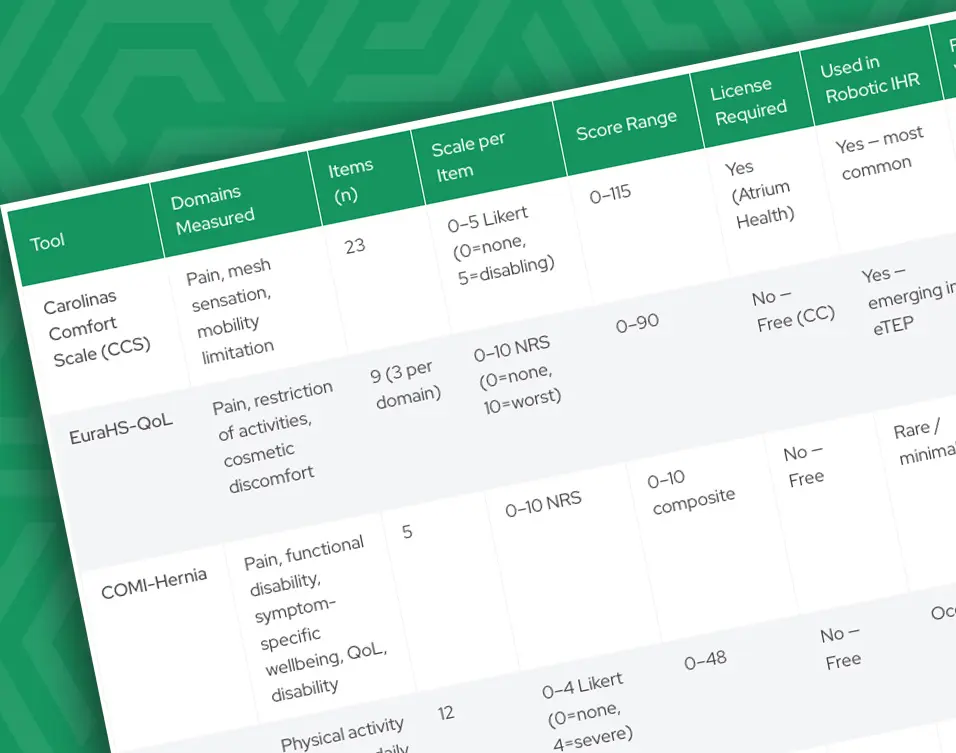
To help navigate the lack of standardized PROM selection in inguinal hernia repair, the chart below compares the most commonly used disease-specific instruments based on domains measured, scoring structure, validation status, and use in robotic IHR studies.
Patient-Reported Outcome Measures (PROMs) | Robotic & Laparoscopic Inguinal Hernia Repair
| Tool | Domains Measured | Items (n) | Scale per Item | Score Range | License Required | Used in Robotic IHR | Formally Validated |
|---|---|---|---|---|---|---|---|
| Carolinas Comfort Scale (CCS) | Pain, mesh sensation, mobility limitation | 23 | 0–5 Likert (0=none, 5=disabling) | 0–115 | Yes (Atrium Health) | Yes — most common | Partial (content validity lacking) |
| EuraHS-QoL | Pain, restriction of activities, cosmetic discomfort | 9 (3 per domain) | 0–10 NRS (0=none, 10=worst) | 0–90 | No — Free (CC) | Yes — emerging in eTEP | Yes — multicenter RCT (Muysoms 2016) |
| COMI-Hernia | Pain, functional disability, symptom-specific wellbeing, QoL, disability | 5 | 0–10 NRS | 0–10 composite | No — Free | Rare / minimal | Partial (adapted from back pain COMI) |
| Activities Assessment Scale (AAS) | Physical activity limitations, daily functioning | 12 | 0–4 Likert (0=none, 4=severe) | 0–48 | No — Free | Occasional | Partial (content validity lacking) |
| HerQLes | Functional status, pain, activity limitations, body image | 12 | 0–4 Likert | 0–100 (normalized) | No — Free | Rarely (ventral hernia focus) | Yes — validated for AWR/ventral hernia |